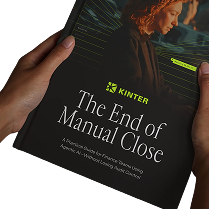

Before Kinter, we were building an integration platform, and it was going well. We were powering financial workflows for enterprises like Amazon.
Then, I did something most founders won't. I looked at what we'd spent five years building and decided to walk away from it. Not because it wasn't working, but because we could see what was coming. In the era of vibe coding, software is becoming a commodity. The moats we'd spent years building were eroding in real time.
So we made the hardest call: burn it down, start over. That decision led us here.
The ledger problem.
Every company on earth, whether it knows it or not, is governed by a ledger. Not a product roadmap, not a pitch deck, not a Slack channel. A ledger. The numbers are the ground truth. When the numbers are wrong, decisions are wrong. When the numbers are late, decisions are late. When the numbers are clean and current, the entire company gets smarter.
This is the thing most people miss about accounting. They think it's back office. Compliance. A cost center. It's not. The ledger is the spinal cord of the business. Every decision – hiring, investing, expanding, cutting – runs through it. And in most companies, that spinal cord is operating on a 30-day delay.
The reason is simple: the work is still done by hand. Not much has meaningfully changed since Excel shipped in 1985 – over forty years ago. In an era where code is commoditized, apps can be prototyped with a snap, and infrastructure spins up in seconds, the majority of finance teams still close their books manually.
The checklists may have moved online, but someone still has to do every line of it.
The vanishing workforce.
Here's what turns a broken process into a crisis. Since 2019, more than 300,000 accountants and auditors have left the U.S. workforce — about a 17% decline. Roughly 75% of current CPAs are at or near retirement age, and only about 1.4% of college students are choosing accounting as their major, a multi-decade low. The people who do this work are disappearing.
But the need for them is only growing.
AI has democratized software, more people are starting businesses than ever before, and every one of those businesses needs books closed, taxes filed, dollars accounted for.
The workforce is shrinking. The workload is exploding. Something has to give.
Kill the copilot.
For three years after ChatGPT launched, everyone was building wrappers. Copilots. Glorified autocomplete. LLMs could pass the CPA exam, but without the infrastructure to actually take action, to call systems, handle complexity, and learn from mistakes, they were party tricks.
That changed in late 2025. Advances in deep agents, connectivity protocols, and model capabilities made it possible to build something fundamentally different. Not copilots. Autopilots: agents that do work proactively, that learn how your team operates, that get better every cycle. Agents that are more akin to a new employee than a tool a person uses.
The tech industry is obsessed with copilots. Put AI in the sidebar. Let it suggest things. Keep a human in the loop on every keystroke. It's cool but that's not a workforce – it's a spellchecker. The entire industry converged on the wrong answer.
The entire value proposition of an accountant is that you hand them work and it gets done. An agent should be no different. You don't hover over your controller's shoulder while they reconcile a bank statement. You shouldn't have to hover over your agent either.
We don't need more copilots. We need a workforce.
AI accountants.
At Kinter, we are building AI accountants. The first trustworthy agentic workforce for accounting.
We've spoken to nearly 400 accountants. We expected resistance. What we got instead was something we didn't anticipate: relief. Controllers who have been doing the same tedious accrual process for fifteen years, not because they love it, but because no one has ever given them a way out. People who went into accounting because they wanted to solve hard problems, not copy numbers between spreadsheets at 11pm on a Tuesday before a board meeting.
They're not afraid of AI accountants. They're waiting for them.
Think about what a finance team actually does every month. A controller sits down, pulls bank statements, and starts matching transactions against the general ledger. Line by line. Hundreds, oftentimes thousands of transactions. They flag the exceptions, investigate the ones that don't match, book the adjustments, calculate the accruals, prepare the journal entries, and assemble the reconciliation package for review. Then they do it again for the next account. And the next. This takes days, sometimes weeks for work that is overwhelmingly pattern-based and rule-driven.
Now imagine a workforce of agents that does this continuously. Not once a month, not on a deadline, but always. One agent reconciles bank accounts the moment transactions clear. Another monitors for accruals that need to be booked. Another runs variance analysis against the prior period and flags anomalies before anyone asks. The books aren't closed once a month. They're always closed.
In our conversations with accountants, we were shocked to hear that most finance teams still close their books 14 to 21 days after the month ends. In 2026, every system we touch runs on real-time, down-to-the-millisecond data, except the resource people care about most: money.
When the books are always clean, everything downstream transforms. Forecasting becomes more accurate. Budgeting becomes responsive. The CFO stops making decisions on month-old data and starts running the business in real time. The nervous system finally catches up to the body.
And with clean books, your workforce expands naturally. Flux analysis. Fraud detection. FP&A. Ultimately, tax and audit.
It all comes back to integration.
AI is the breakthrough. But a breakthrough without access to the data is just a demo. Reconciliation, accruals, variance analysis: these are all fundamentally about pulling data from one system, comparing it to another, and acting on the delta. The smartest agent in the world is useless if it can't read your bank feed or write back to your ERP. The agent layer is only as powerful as the integration layer underneath it.
The integration platform we left behind? It wasn't a detour. It turns out that the best preparation for building an autonomous finance workforce was spending years solving the connectivity problem that makes autonomy possible.
The revolution is here.
As more businesses are built and the supply of accountants tightens, the shift from manual work and delayed closes to real-time intelligence will accelerate. The teams that win will pair great accountants with AI to keep their books clean, current, and decision-ready.
The result is a new standard for finance. The books are always closed. The numbers are always clean. And finance teams finally get to do what they were actually hired to do. That's what we're building. And we're just getting started.