

In 1935, Boeing built the most advanced aircraft ever made. On its demonstration flight, it crashed. Not because of a mechanical failure. Because the pilot forgot to disengage the elevator locks.
The plane was fine. The operation was just too complex to leave to human memory.
Boeing's answer was the preflight checklist. With that single change, the B-17 flew 1.8 million hours without incident. Seventy years later, a doctor at Johns Hopkins applied the same logic to ICUs. A five-item checklist for central line procedures. Fifteen months in: 43 infections prevented, 8 deaths avoided. When Michigan rolled it out statewide, an estimated 1,500 lives were saved in eighteen months.
The insight was the same in both cases. In high-stakes, complex work, the problem is never competence. It's that human memory is insufficient for precision at scale.
Accounting belongs in that category. The close isn't paperwork. It's the operating system of every business decision that follows.
That story is where we started when we built Kinter's brand. Not with a mood board. Not with a brief. With the question: what does accounting actually need, and has anyone ever told the truth about it?
The problem.
Finance software has had a branding problem for thirty years. Not a visual problem. A story problem.
The category has been selling efficiency for three decades, and the language of every player has converged into something you can no longer tell apart. "Trustworthy. Secure. Purpose-built." Walk the floor of any CFO conference and you'll lose track of which booth you're standing in.
In a market moving this fast, that sameness isn't safe. It's a liability.
I've watched brand blur happen at scale, and I've watched companies pay for it. When I joined Workato, we were thirty people. By the time I left, we were over 800 and had raised a Series E at a $5.7 billion valuation. The early brand work — establishing a clear point of view, building a visual language, choosing what we would never say — was table stakes. Not decoration. The cost of being taken seriously in a category fight.
At Newlab, I got to do the opposite: build a brand for ideas that were genuinely hard to explain. Economic development layered with deep tech, frontier research, industrial innovation. The job was figuring out how to make complicated things feel urgent and human. Explaining how small regulation changes could enable massive innovation. Showing, not telling.
I brought both of those lenses to Kinter.
The decision.
When Gregg, our CEO, made the call to walk away from Alloy Automation, he wasn't in retreat. He was reading the market correctly. He'd spent five years building an integration platform powering financial workflows for enterprises like Amazon. It was working. He walked away anyway because he could see the moat eroding. In the era of AI, software was becoming a commodity. What to build wasn't a better platform. It was a workforce.
When you've just made that call, you don't get to take six months on brand exploration. You move.
We built Kinter's brand while talking to over 600 accountants, shaping the product in real time, listening for what the category had never said out loud. The brief didn't come from a strategy deck. It came from those conversations.
A team of three built it. I brought in Joelle McKenna as creative director to work with Filipe Soares, our in-house designer. AI compressed what would have taken a large agency months into something a small team could own, iterate, and sharpen. Every decision had to answer one question: does this make the idea clearer, or does it just make it prettier?
The build.
Two source ideas shaped the entire visual system: diamond cutting and aviation.
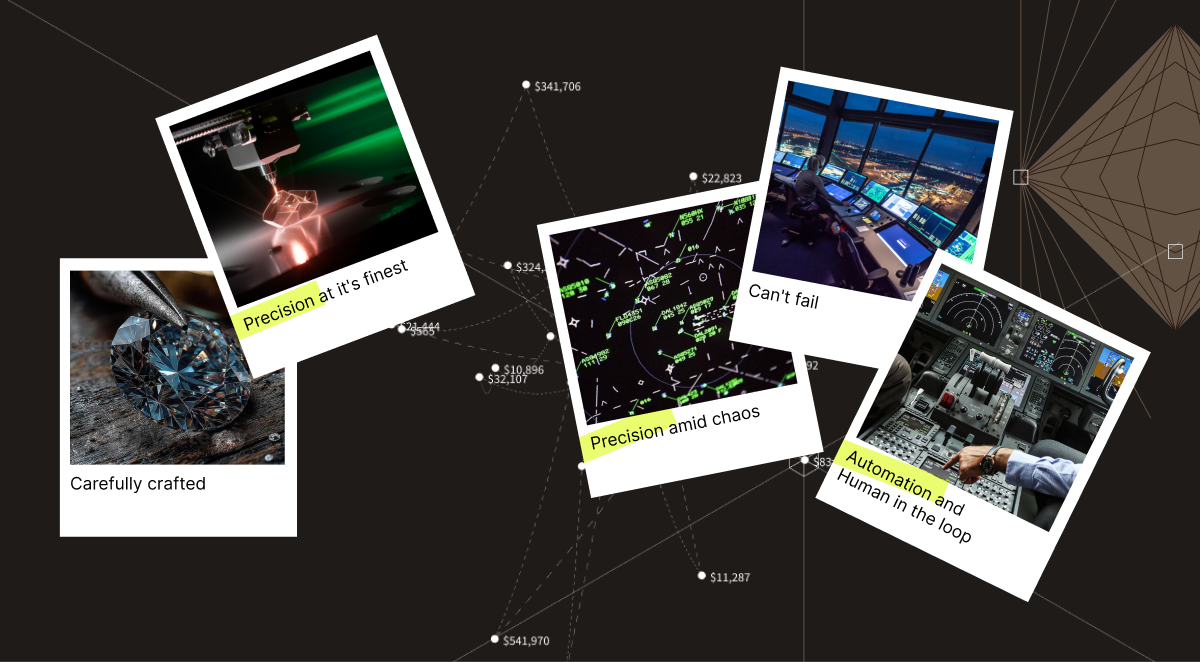
Both disciplines share something accounting also demands. You don't get to be approximately right. One miscut ruins the clarity of the stone. One miscalculation and the plane doesn't land. Accounting is the same. The close has to be right, every time, or everything downstream is wrong.
The checklist was the right answer for 1935. The question for accounting in 2026 is different: what if the executor didn't need to be human at all? What if the system ran the checklist itself, and you just reviewed the result?
That's what Kinter is. Not a better checklist. The AI accountant that runs it.
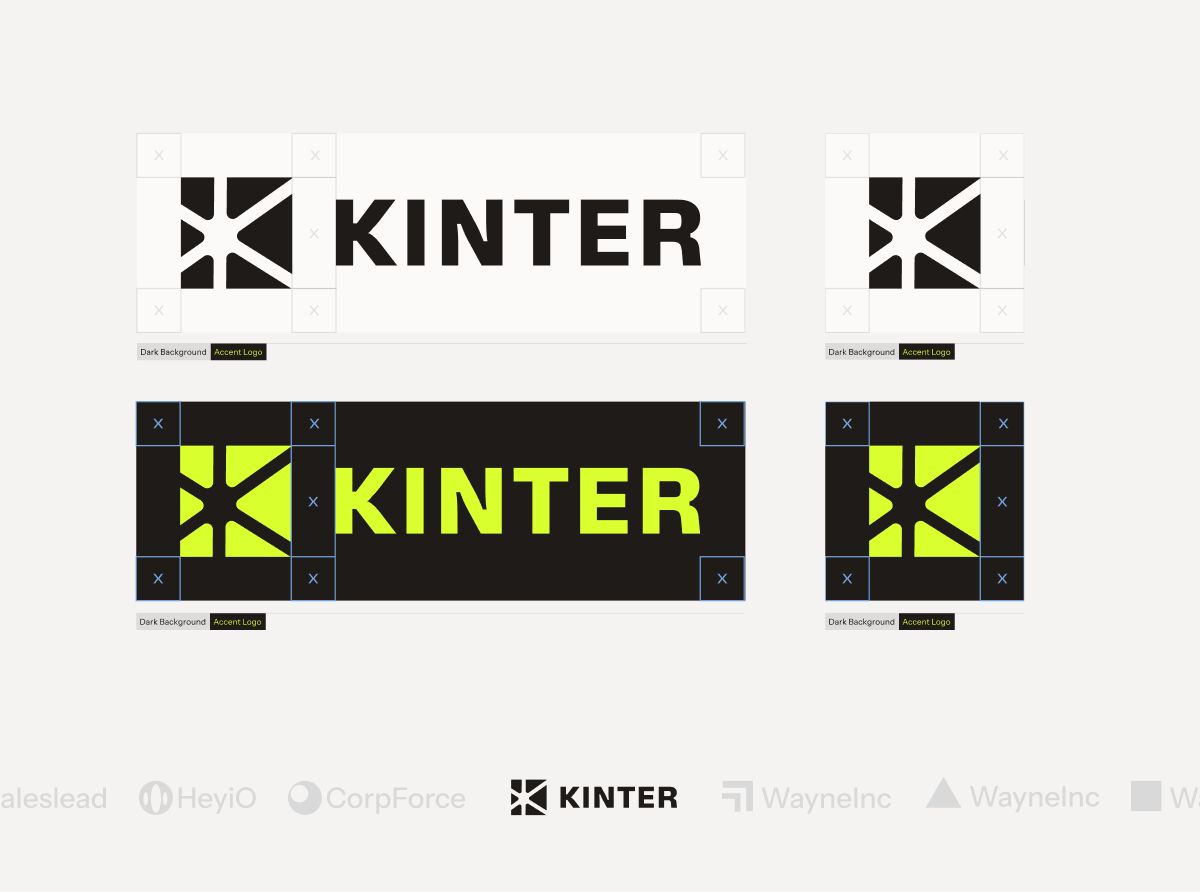
The logo follows from that logic: a geometric mark built from precision and motion. Four directional elements assembled into a single symbol that signals engineered movement. Not disruption for its own sake. Something that moves because it was designed to.
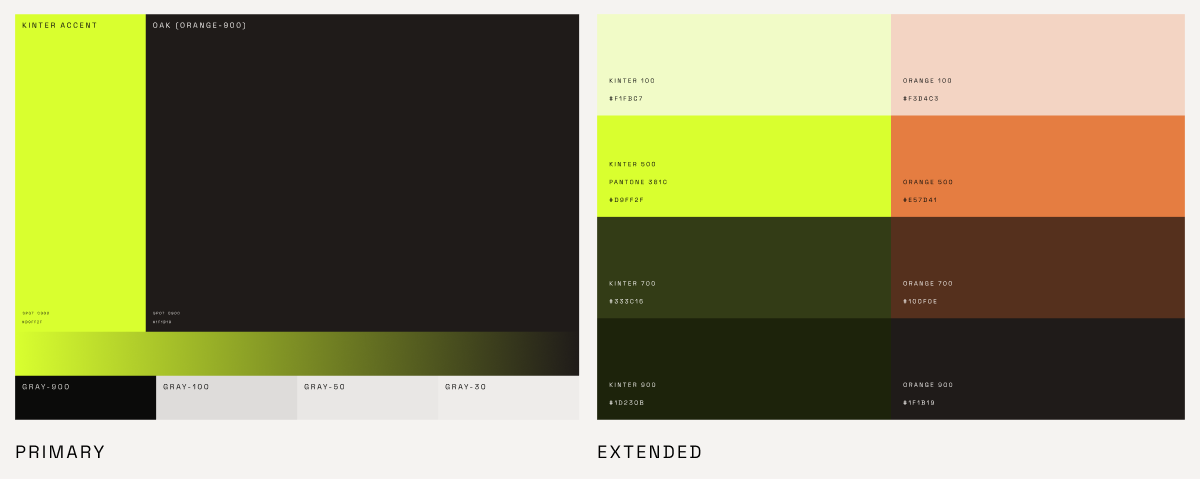
The color palette is a deliberate argument. Finance software reaches for navy and grey because they signal safety. We chose something different, not to be contrarian, but because safe colors tell the wrong story. The Kinter accent, a bright neon yellow-green, signals speed. Speed is the product. Speed is what you get when AI handles the execution layer and your team gets to think instead of do. The darker tones, a deep academic brown and hunter green, signal prestige and permanence. They feel like old libraries. CFO offices that have seen a hundred close cycles. We're not replacing that history. We're accelerating it.
The combination is the brand thesis in visual form: modernity meeting tradition. Speed arriving in a form the profession can trust.
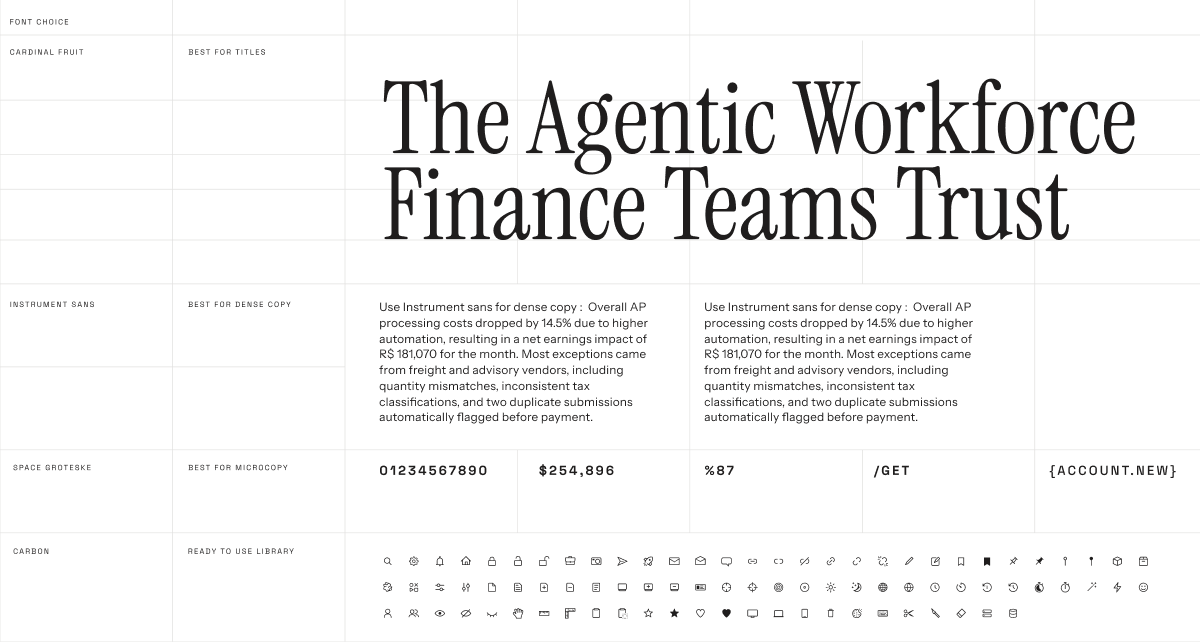
Typography follows the same logic. Cardinal Fruit, our headline font, is a humanist serif with rounded ends: credible and warm at the same time. Space Grotesk handles numbers and data, because in finance, numbers deserve their own visual language. Instrument Sans carries body copy, clear, legible, unpretentious.
Photography is human and specific. We don't use stock imagery of dashboards or charts. We use people, with cinematic lighting. Accounting should be respected. The accountant should be elevated.

The voice came last, and it's the hardest part to get right. We speak with authority. Not formal or stiff, but in the sense that we know what we're talking about and we say it plainly: A new kind of power for finance teams. They close the books. You crush the board meeting.
The trap.
The most common and most expensive mistake fast-moving companies make is what I've started calling story lag. Product moves fast. Brand moves slow. By the time the brand catches up, competitors have already shaped how the category thinks about you. You're playing defense on someone else's field.
The antidote is not to wait for the perfect moment. In a market moving at this speed, the perfect moment is the one you create.
Build from conviction, not consensus. If everyone on your team thinks the brand is safe, you haven't gone far enough. Our leadership team was pushed past their comfort zone. In the end they couldn't be more proud of where it landed.
And remember that the brand isn't the marketing team's job alone. It's how the whole company shows up, in the product, in the customer conversation, in the post your CEO writes at 11pm because he actually believes what he's saying.
When those things align, you don't have a brand strategy. You have a company that knows who it is.
That's what we built.